
15 Sept 2026 · 5 min read
What is innovation intelligence? A practical guide for FMCG leaders

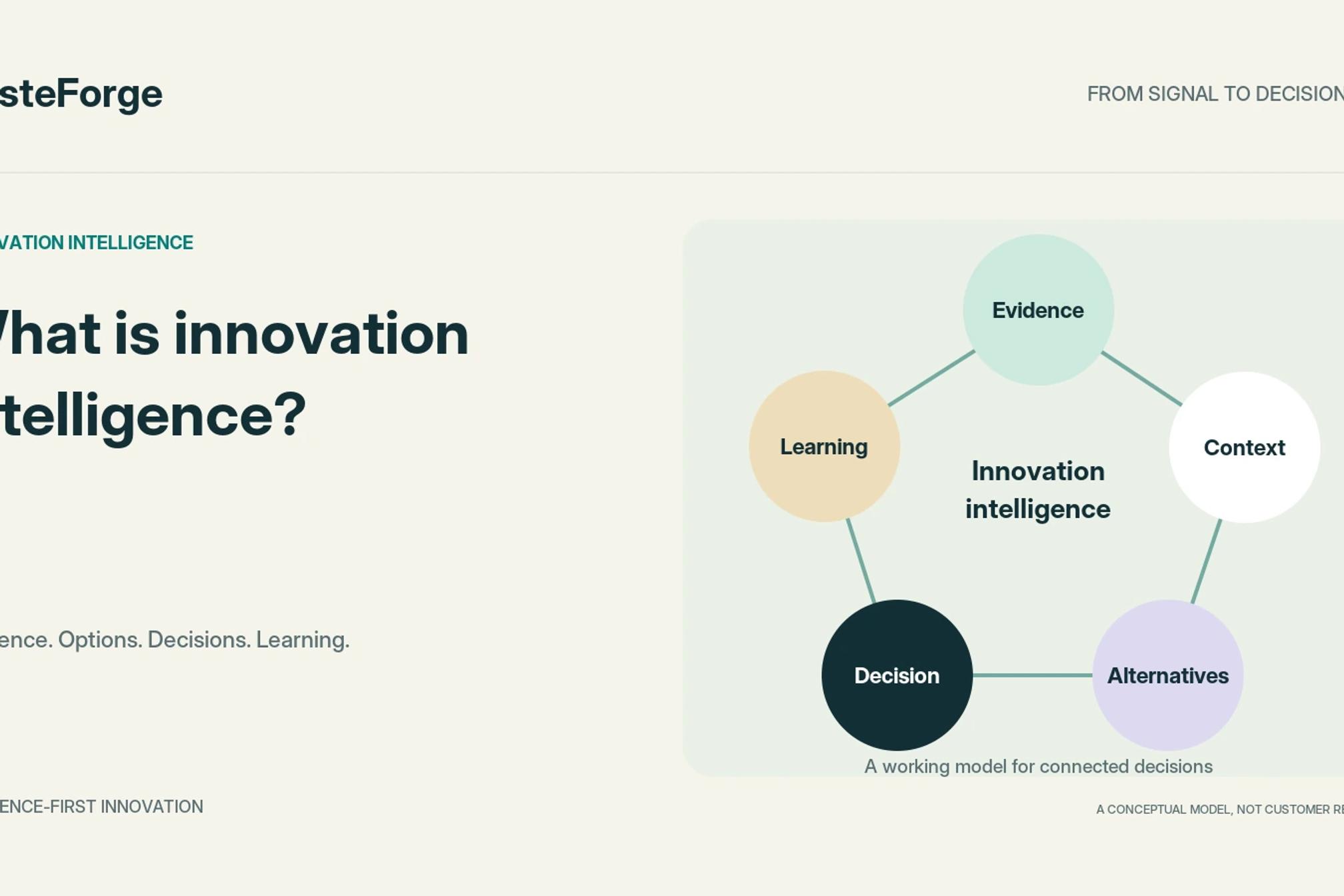
How market evidence, company knowledge and decision support connect across the product innovation process.
At TasteForge, we use innovation intelligence to describe the capability to connect evidence, business context, alternatives, decisions and outcomes across product innovation. It brings together the knowledge a team needs to choose its next step and retain what it learns.
In a food or drink business, this can involve consumer research, product specifications, supplier constraints, sales data and experience from earlier launches. The practical question is how those inputs support the decisions made by innovation, commercial and technical teams.
This guide explains the capability through a product-development example, outlines the role of technology and proposes a way to assess maturity. The definition describes our approach and the wider direction we are building towards.
The decisions innovation intelligence supports
A category name is only useful when it helps a buyer understand the work.
Market intelligence can inform a team about consumers, competitors and changing conditions. Innovation management can organise ideas, resources and delivery. Decision support can help compare alternatives under explicit objectives and constraints. These capabilities can overlap within an organisation or a single tool.
Our focus is the continuity between them. Can a team follow a relevant observation into an opportunity hypothesis, a decision, a test and an eventual learning? Can it distinguish what was known from what was assumed along that path?
Innovation intelligence should make that continuity practical. It should not require an organisation to rename everything it already does well.
Five questions for assessing an innovation opportunity
The first question is: what are we trying to decide? Approving research, selecting a prototype and committing to a launch require different levels of evidence. A system should not treat them as interchangeable approvals.
The second is: what do we know? This includes the origin, scope and date of the evidence, not merely the conclusion copied into a presentation.
The third is: what options are realistic for this business? A relevant consumer need does not remove production limits, channel requirements, resource constraints or existing portfolio commitments.
The fourth is: what would change the decision? A missing supplier quote may matter more than another broad market report. A changed distribution assumption may invalidate an otherwise attractive scenario.
The fifth is: what should we retain? The next team needs access to the reasoning, the test and its conditions, not just the final approval status.
These are connected questions. Answering only one of them more quickly can still leave the overall decision unsupported.
An example from market research to launch review
Consider a fictional food producer exploring a smaller pack for an existing snack. The initial observation is that some shoppers describe the current format as too large for a particular occasion.
That observation supports a question, not a finished business case. The team needs to understand the relevant shoppers, whether the pack is genuinely the barrier, and how a smaller format would change perceived value and production economics.
It compares three alternatives: retain the current pack, test a smaller pack, or change the proposition without changing the pack. It records the assumptions behind each option.
The next decision is a bounded test. The team agrees what the test should resolve and what evidence would justify further work. After the test, it records both the result and the actual conditions.
The durable asset is the connection between the original question, the alternatives, the evidence, the commitment and the observation. Another team can revisit that connection without treating the first conclusion as a universal rule.
How research, rules and predictive models work together
Different parts of the work call for different methods. Search and retrieval can locate relevant material. Rules can check explicit requirements. Statistical models can estimate defined outcomes. Scenario calculations can expose sensitivity. People can interpret trade-offs and take responsibility for commitments.
No single technique should be credited with doing all of these jobs simply because the interface has an AI label.
The right architecture is therefore a design choice about responsibilities. What needs to be calculated? What needs to be predicted? What can be checked deterministically? What remains a judgement call? Each output should be named and evaluated accordingly.
For AI-enabled parts of that architecture, the NIST AI Risk Management Framework provides a useful external reference: its core connects governance, context mapping, measurement and risk management. It is not a certification of any TasteForge capability. [1]
Assessing the maturity of an innovation intelligence capability
We propose a practical progression.
At the first level, a team can assemble a credible basis for one decision. At the next, it can preserve that basis across research, development and commercial handoffs. Later, it can reuse the relevant history and identify decisions that deserve review when conditions change.
Automation can support each level. It is not a substitute for them. Automatically refreshing an unsupported claim does not improve the decision. Recording more interactions does not prove that a model has become more accurate.
Maturity should be visible in the work: fewer unexplained assumptions, clearer responsibilities, more usable prior evidence and an evaluation process that can reveal when the system is wrong.
TasteForge's approach to innovation intelligence
Our starting point is decision support for FMCG innovation: connecting company context, market evidence and the work of developing and evaluating product opportunities. The wider ambition is an innovation intelligence layer that preserves and improves those connections across projects.
The sequence is intentional. Support a real decision. Make the next handoff better. Retain what was learned. Expand the scope when the capability and its value are demonstrated.
For a buyer, the first evaluation can be equally concrete. Pick one recent decision and ask whether the team can reconstruct its alternatives, supporting evidence, assumptions and outcome. Then identify the most expensive break in that chain.
That is a more useful starting point than asking whether the organisation has enough AI.
Innovation intelligence should make it easier to explain why an option deserves the next investment, and what the organisation learned after making it.
Source
[1] NIST, AI Risk Management Framework 1.0, Core. Used for the governance and evaluation reference, not as evidence of product performance. https://airc.nist.gov/airmf-resources/airmf/5-sec-core/