
15 Sept 2026 · 5 min read
How to write an innovation brief: evidence, assumptions and next steps

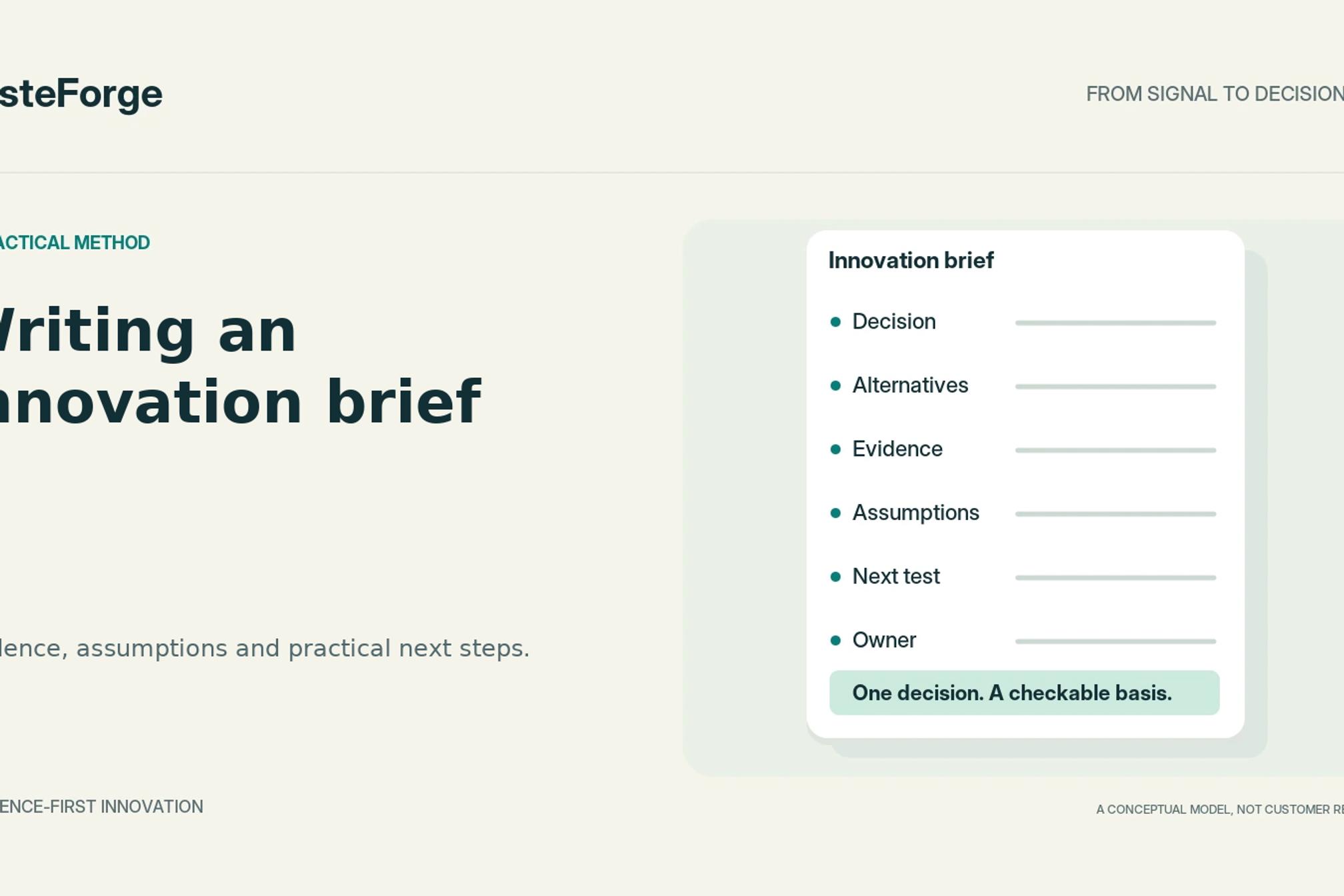
A practical structure for documenting the opportunity, comparing options and agreeing what to investigate next.
An innovation brief gives a team a shared basis for the next development decision. It should explain the opportunity, the alternatives being considered, the evidence available and the work the team is being asked to approve.
A brief for exploratory research will need a different level of detail from a brief supporting a production commitment. In both cases, the reader should be able to identify the decision, its owner and the assumptions that still require investigation.
The structure below keeps the main brief short enough to use in a meeting, with links to the underlying evidence. A fictional fruit-snack example shows how the fields work together.
Define the decision, owner and scope
Start with a verb and a boundary: approve a production trial, select two concepts for research, or decide whether a proposed price deserves further testing.
Then specify who owns the decision, when it is needed and what resources it commits. A date without a decision owner creates a deadline, not accountability.
Keep the product vision separate. The vision can describe the larger opportunity. The decision brief should identify the next commitment that is justified now.
This also prevents a promising research finding from being silently converted into approval for a much larger investment.
Set out the alternatives and comparison criteria
A brief with only one option can become an argument for a preselected answer.
Include the realistic alternatives, not deliberately weak comparisons. Depending on the question, those might be a different format, a smaller experiment, continuing with an existing product or deferring until a condition changes.
State what the alternatives are being compared against: consumer relevance, commercial contribution, delivery feasibility, strategic role or another explicit objective. Where priorities conflict, leave the conflict visible.
A lower-risk choice is not automatically better. An ambitious choice is not automatically unjustified. The brief should show what each requires and what the team is choosing to accept.
Document evidence, assumptions and requirements
Evidence describes an observation or a supported conclusion. An assumption is something the case currently treats as true without sufficient confirmation. A requirement specifies a condition an option must satisfy.
For example, an observed response in a concept test is evidence about the tested proposition and sample. A provisional ingredient cost is an assumption until checked against the relevant supply conditions. A maximum acceptable production change may be a business requirement.
These should not be placed in one undifferentiated list of supporting facts.
For each important evidence item, retain its source, date, market or population, and what it can actually support. Link to the original research where access rights allow. A summary should not remove the context that limits a claim.
A worked example: a fruit-snack multipack brief
The example below is fictional and contains no TasteForge customer result. It shows the structure rather than a recommendation to launch a particular product.
Brief field: Decision
Illustrative entry: Approve a small production and consumer test for a fruit-snack multipack.
Brief field: Decision owner
Illustrative entry: Commercial lead, with input from product development and operations.
Brief field: Intended use
Illustrative entry: A convenient portion for a weekday packed lunch.
Brief field: Alternatives
Illustrative entry: Existing single pack; a multipack; a smaller single pack.
Brief field: Objective
Illustrative entry: Learn whether the proposed format addresses the intended occasion at a workable price and production setup.
Brief field: Evidence available
Illustrative entry: An internal record of customer questions and an initial packaging feasibility assessment. Both need their original context attached.
Brief field: Assumptions
Illustrative entry: The proposed portion is appropriate; shoppers understand the value; the packing process is practical.
Brief field: Hard constraint
Illustrative entry: Do not commit to production equipment before the trial resolves feasibility.
Brief field: Next evidence
Illustrative entry: A supplier quotation, a production trial and research on the proposed offer.
Brief field: Decision rule
Illustrative entry: Continue only if the trial meets the technical requirements and the research supports further commercial testing.
Brief field: Review trigger
Illustrative entry: Trial completion, a material cost change or evidence that the intended occasion is wrong.
The example deliberately stops short of a launch recommendation. That is what makes the commitment proportionate to the evidence.
Specify the question each test must answer
A list of unknowns is useful only when it changes the work plan.
Ask which unresolved assumption could overturn the next decision. Then ask what observation would distinguish the competing explanations. A consumer interview may clarify a problem; it cannot establish production feasibility. A production trial can check a process; it cannot establish willingness to buy at the proposed price.
Define the intended use of the result before collecting it. Avoid deciding afterwards that whichever number looks strongest was the real success measure.
Give the work an owner and a review point. Where several uncertainties depend on one another, start with the one that determines whether the remaining work is worth doing.
Maintain a current brief and a record of earlier decisions
The working brief should change when material evidence changes. The record of a past decision should not.
Keep a snapshot of the brief used at the decision meeting. Maintain a current version for subsequent work. Record whether a revision came from new evidence, a changed objective, a revised assumption or a corrected error.
This distinction makes the brief useful beyond approval. It becomes the starting point for an experiment review, a retailer conversation and a later assessment of what the team learned.
It also makes disagreement more productive. Colleagues can identify which input or priority they challenge rather than argue over a conclusion detached from its basis.
Introduce the brief into your existing workflow
This structure can begin in a shared document. Its value does not depend on a particular interface.
Software becomes useful when maintaining the connections manually becomes difficult: one source supports several briefs, a change affects multiple concepts, or different teams need different permissions and views of the same decision.
At TasteForge, our work focuses on connecting these briefs to the evidence, assessments and follow-up actions across the innovation process.
At the next gate meeting, test the brief with one question: can every participant explain exactly what is being approved, on what basis, and what remains unresolved?
This is an original TasteForge editorial method and a fictional worked example, not a formal standard or a report of measured customer outcomes.