
15 Sept 2026 · 6 min read
How to assess the commercial potential of a product idea

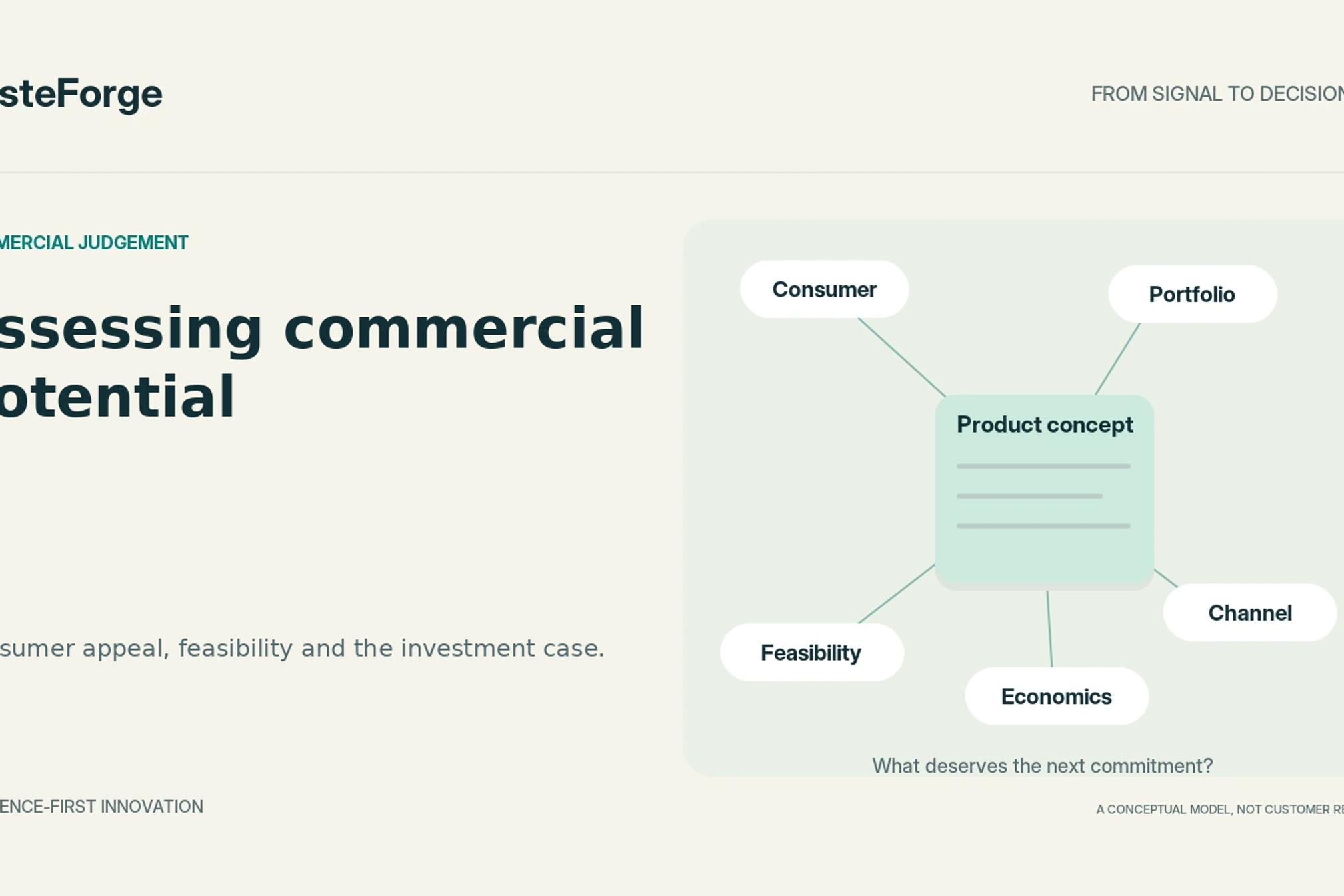
A practical framework for evaluating consumer appeal, feasibility, economics and the next investment.
Assessing a product idea means bringing several perspectives into the same review. Consumer research explains the appeal of the proposition. Operations checks whether it can be produced and supplied. Finance examines the economics. Sales considers how it could reach the shopper.
The task is to combine those perspectives into a specific investment decision: which version should the business develop, under which conditions, and what should it commit next?
This article sets out a practical framework for that assessment. It covers five dimensions of commercial potential, the trade-offs between them and a decision brief that makes the next step clear.
Five dimensions to assess before investing in a product idea
"Is this a good concept?" sounds precise. In practice, it can contain several different questions.
Is it relevant to a particular consumer? Does it add something useful to the portfolio? Can the business make and supply it reliably? Can the economics work? Is there a credible route to the shopper?
A positive answer to one question cannot automatically answer the others. Consumer enthusiasm does not confirm a supplier quotation. A feasible recipe does not establish demand. An attractive selling price does not demonstrate an acceptable contribution after the costs of reaching the market.
This does not make consumer research less valuable. It makes its role more specific. NIQ's Launch Fast, Learn Faster research distinguishes early trial from repeat purchasing and describes how launch performance varies across categories and markets. That is a useful reminder to define the outcome being evaluated rather than compress everything into "success." [1]
Our proposed discipline is straightforward: make each perspective visible, then show where they support or contradict one another.
Define the investment decision and the evidence it requires
Before commissioning another report or generating more concepts, write down the decision that the work must support.
For a healthier-snacking project, a useful decision statement is: "Decide whether to fund a small consumer and production test for a new snack format, within the existing manufacturing setup."
That statement identifies a commitment. It also limits the question. The team is not being asked to approve a national launch. It is being asked whether the next learning step is worth taking.
That difference matters because the evidence required to justify a reversible test is not necessarily sufficient to justify a large, difficult-to-reverse investment. The decision, its consequences and its reversibility should determine how much uncertainty the team can accept.
This is also a more useful starting point for technology. A system can help assemble the relevant information only when it is clear what the information is for.
Compare differentiation, production costs and route to market
Consider an illustrative example, not a customer result.
A small producer is evaluating two versions of a fruit snack. One uses a distinctive ingredient that gives the concept a strong story. The other uses an ingredient already available through an established supplier.
The first option may be more differentiated. It may also require a higher minimum order, a different process and a retail price that the business has not tested. The second may be easier to produce but harder to distinguish on shelf.
A useful discussion does not end with "the first one scores higher."
It asks what would have to be true for each option to deserve investment. Can the producer obtain a workable quotation? Does the intended shopper value the difference at the proposed price? Does the new format serve a different occasion, or mainly compete with an existing product?
Commercial potential depends on the product and the conditions under which this business can bring it to market.
Document the assessment in a decision brief
We recommend capturing the next decision on one page, with access to the underlying evidence.
Start with the decision and the alternatives, including an explicit option to defer or do nothing. State the outcome the team is trying to improve and the constraints that cannot be negotiated away.
Then separate what is observed from what is assumed. A measured purchase pattern, an expert judgement and a model estimate can all be useful, but they are not interchangeable. Attach the source, date and relevant market or population to each important claim.
Finally, identify the unresolved question most likely to change the decision. Give someone responsibility for resolving it, and record when the team will revisit the choice.
The brief should make the available evidence and remaining uncertainties easy to inspect.
A good brief can say: "The consumer case is promising. The commercial case is not yet established. The next step is a supplier quote and a price test, not a launch commitment."
That is progress, even though it is not a dramatic recommendation.
Share assumptions across research, finance and sales
Innovation teams do not need to abandon their research partners, spreadsheets, product systems or existing models to work this way.
The design question is how information survives the handoff between them.
When the concept changes, can the team see which assumptions need another look? When Finance challenges the margin, can it trace the inputs rather than debate a number detached from its source? When Sales prepares a retail conversation, can it distinguish demonstrated demand from an attractive hypothesis?
At TasteForge, this is the direction of our work: connecting company context, market evidence and innovation workflows so that the next decision has an explicit basis. More advanced prediction should strengthen that basis where it is validated, not replace it with a more confident-looking answer.
Measure the quality and efficiency of concept reviews
The first test of this approach does not have to be a claim about dramatically higher launch success.
Start closer to the work. Measure how long it takes to assemble a usable decision brief. Check whether material assumptions have sources and owners. Track whether a new piece of evidence can be connected to the concepts it affects. Review how often an agreed learning step actually resolves the question it was designed to answer.
Those are proposed measures, not promised TasteForge results. They give a pilot something concrete to evaluate before making broader claims about commercial impact.
A good product idea deserves serious attention. A good business decision requires something more: a clear choice, relevant evidence, visible uncertainty and an accountable next step.
This gives the team a shared basis for exercising its judgement.
At your next concept review, ask one additional question: what evidence would change our decision?
Source
[1] NielsenIQ, Launch Fast, Learn Faster (2026). Research across selected European markets; not a universal Norwegian launch-success benchmark. https://nielseniq.com/global/en/insights/report/2026/launch-fast-learn-faster/