
15 Sept 2026 · 5 min read
How to capture and reuse learning from innovation projects

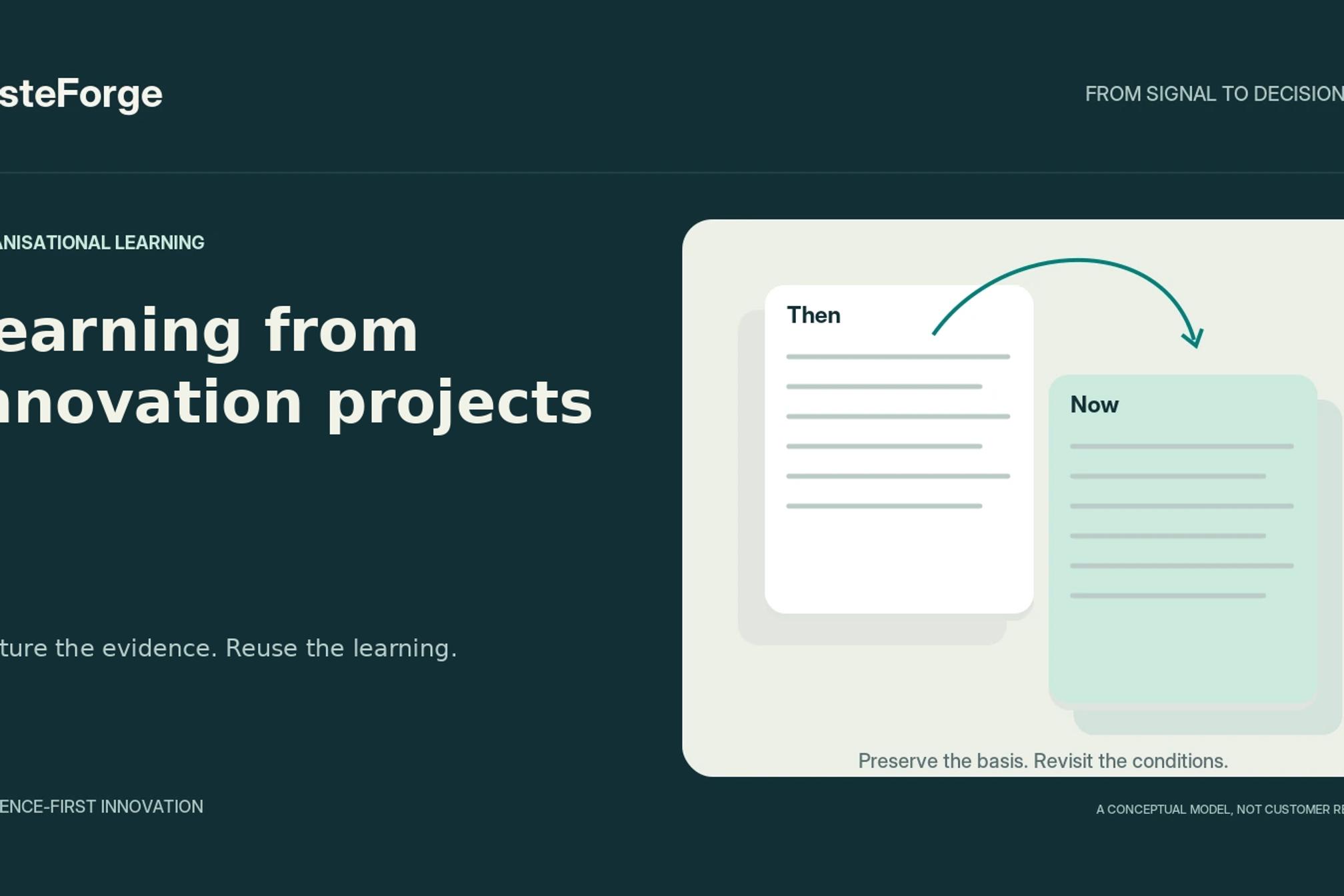
What to capture from research, development and launch reviews, and how to make it useful to the next project.
Reusing learning from an innovation project requires enough detail to understand what happened and why. A future team needs the research findings, development constraints, decision rationale and any observed results, together with the conditions that shaped them.
Consider a hypothetical concept that was paused after a production trial. If a similar idea returns a year later, the team needs to identify the original technical issue, check whether it still applies and decide which work can be reused.
This article describes a manageable way to capture that knowledge during the project and connect it to future work. We use the term decision memory for the records linking evidence, choices and outcomes.
What to record so future teams can reuse the learning
A project archive can contain the brief, the research, the business case and the final presentation. That is valuable.
Decision memory connects those materials to the choices they informed.
It records what the team was trying to decide, which alternatives it considered, what evidence it had, what it assumed, what it chose and what happened afterwards. It also preserves the context that limits where the learning can be reused.
Without that context, a statement such as "consumers rejected the format" is difficult to interpret. Which consumers? Under which proposition? At what price? Was the issue the format itself, the communication or something else the test could not separate?
Keep the record proportionate to the project while making the important conclusions inspectable.
Record the conditions behind each finding
Consider a hypothetical product that was paused because it could not maintain the required texture through the intended distribution conditions.
"Do not pursue this product" is one possible record.
"This formulation did not maintain the required texture under the tested conditions; the distribution requirement remains unresolved" is a more useful one.
The second record does not promise that another formulation will work. It tells the next team where the problem was and what it would need to test. If the process, formulation or distribution model changes, the old decision can be reconsidered without pretending the earlier evidence never existed.
This is how learning becomes reusable without becoming dogma.
Distinguish project decisions from observed outcomes
A project being rejected does not establish that it would have failed in the market. The launch never happened, so that outcome was not observed.
Equally, a disappointing launch does not, by itself, prove that the original decision was unreasonable. To assess the decision, the team needs to examine the evidence available at the time, the alternatives and what changed during execution.
This distinction matters when turning project history into data for future models. "Paused," "technically infeasible," "failed a consumer test" and "launched below a commercial threshold" are different events. Treating them as a single failure label would erase information the business needs.
A decision record should therefore distinguish the action taken from the evidence collected and from the outcome observed. It should allow an unresolved outcome to remain unresolved.
Capture a short decision record at each review
We recommend starting with a short record, attached to the work rather than written months later.
Describe the decision and its owner. List the alternatives considered. Preserve the material evidence and assumptions as they stood at that moment. Record the chosen action, the reason for it and the condition that would trigger another review.
When an experiment or launch produces new information, link it back to the original question. Did the test resolve the uncertainty it was designed to address? Did the market response match the expectation? Were the actual launch conditions materially different from the plan?
Keep a distinction between the historical snapshot and the current evidence. A refreshed market report should not silently replace the version used for a decision six months earlier. The business needs both: what it knew then and what it knows now.
Evaluate how recorded learning improves later work
Saving more interactions does not guarantee a better model. Neither does allowing every user action to change a score.
Some interactions are preferences. Some are corrections. Some are observations with an eventual outcome. They need different treatment.
The near-term benefit of decision memory can be operational: finding relevant prior work, recovering the assumptions behind it and avoiding unnecessary repetition. A later predictive benefit must be demonstrated through appropriate evaluation on data that was not used to construct the model.
If the records are inconsistent or the outcomes are missing, the next task may be improving the records rather than training a more complex model.
Track where earlier learning is reused and evaluate whether it improves subsequent work.
Manage access and permission for knowledge reuse
An organisation can benefit from reusing its own knowledge without making that knowledge available to other businesses.
That should be the starting point for enterprise innovation intelligence. Access, publication rights and the purpose of reuse must be explicit. Public examples should use authorised material or clearly labelled illustrations, not confidential project details disguised as generic stories.
Cross-company learning is a separate design and governance question. It should not be implied by a loose promise that "every customer makes the platform smarter." Any shared benchmark needs a legitimate basis, an appropriate method and clear boundaries.
Trustworthy learning requires knowing not only what the system remembers, but who is entitled to use it.
Build a reusable body of innovation knowledge
This is the long-term direction we are pursuing at TasteForge: an intelligence layer that connects evidence, decisions and outcomes across the innovation process.
The sequence matters. Begin by supporting a specific decision well. Connect related decisions across a project. Preserve the evidence and learning that can improve the next project. Expand into broader portfolio and organisational questions as the capability is demonstrated.
Over time, these records can give teams a shared knowledge base that remains useful as projects finish and responsibilities change.
Start by checking one completed project.
Take one completed project. Can your team reconstruct why it proceeded, changed direction or stopped, using the evidence available at the time?
If not, that is a useful place to begin.