
15 Sept 2026 · 5 min read
New product launches: assessing growth and cannibalisation

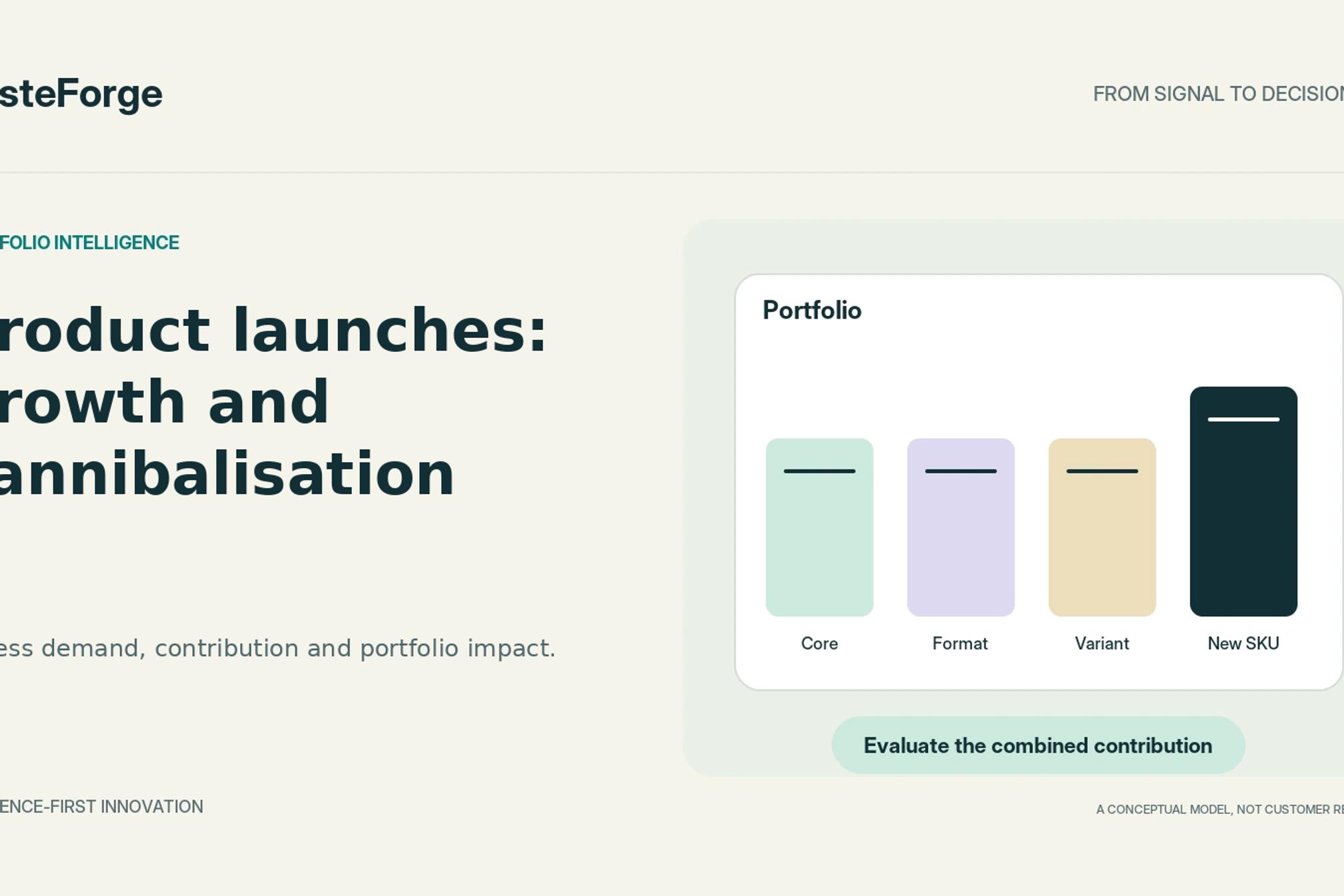
Evaluate where demand comes from, how existing products are affected and what the launch contributes to the portfolio.
Assessing a new product's contribution requires a view of the wider portfolio. Sales can come from existing products, competing brands, new buyers or additional purchase occasions. Each source has different implications for the business.
The review also needs to account for margins, launch support, production requirements and changes in distribution. Together, these determine how the new SKU contributes to the commercial objective behind the launch.
This article explains how to frame that assessment, develop a source-of-demand hypothesis and compare the operational commitments associated with a new product.
Measure product sales and portfolio contribution separately
The distinction is easy to see in a hypothetical arithmetic example.
Suppose an existing range would otherwise have sold 10,000 units in a defined period. With the new SKU, the existing range sells 9,400 units and the new product sells 1,000. The combined total is 10,400 units.
Under that assumed baseline, net portfolio growth is 400 units, not 1,000. The example is illustrative, and the assumed "otherwise" total is not something a real business can simply observe.
In practice, a comparison needs to account for other changes. Seasonality, distribution, price, promotion and supply conditions may affect the result. A decline in an existing SKU does not, by itself, prove that the new one caused it.
The calculation is simple. Establishing a defensible comparison is the harder task.
Define growth at the brand, company and category level
Growth for a SKU, a brand, a supplier portfolio and a retailer category are different outcomes.
A shopper switching from a competitor can grow a supplier's sales without growing the category. A shopper switching between products within the same portfolio may change contribution even when total units do not change. A new format may be intended to defend relevance rather than create immediate volume growth.
State the intended level and measure before judging the launch. Units, revenue and contribution can tell different stories. Pack sizes also need a sensible comparison basis; one pack is not always equivalent to another.
There is no need to pretend that only one outcome matters. There is a need to make the trade-offs explicit.
Evaluate when cannibalisation supports portfolio objectives
A business may deliberately replace an older offer with a more appropriate one. It may accept some internal substitution to improve contribution, address a consumer need or remain competitive.
The question is whether the shift is understood and worthwhile under the business's objectives.
NIQ's historical analysis of targeted innovation describes different routes to incrementality, including trade-up and new usage occasions. It also emphasises the need to align expectations about a product's role within the portfolio. That is a useful frame, not a forecast for a particular launch. [1]
The wrong shortcut is to label every new SKU's revenue as incremental, or every decline in a neighbouring SKU as evidence that the launch should not have happened.
Develop a hypothesis for where demand will come from
Before launch, describe where the proposed demand could come from.
For an illustrative snack extension, the possibilities might include existing brand buyers changing flavour, new buyers choosing the brand, or shoppers using the product for an occasion not previously served.
Attach evidence to each hypothesis where it exists. Keep uncertain allocations as scenario assumptions, not measured facts. Avoid assigning neat percentages merely to make a chart add up.
Then ask what information would help distinguish the explanations after launch. Depending on the question and available rights, that might involve suitable panel or transaction analysis, a carefully designed test, consumer research or a more limited comparison with explicit caveats.
The choice of method matters. Aggregate sales alone may not identify the source of each purchase.
Assessing the operational cost of adding a new SKU
A portfolio decision includes what the organisation must support.
A new SKU may require packaging inventory, production scheduling, commercial attention and working capital. Those are questions to investigate for the actual business, not costs to assume are identical across concepts.
Likewise, retaining the existing assortment is a choice with consequences. The comparison should include the credible alternatives rather than treat "do nothing" as costless and risk-free.
We suggest a compact portfolio brief with five elements: the proposed role, the expected source of demand, the contribution assumptions, the operational implications and the evidence needed to revisit the decision.
That brief can be useful before a detailed model is available. It exposes where the business case depends on an untested belief.
Compare launch, adjustment and alternative investment options
After the relevant observation period, a review might find that the new product recruited buyers, mainly shifted existing purchases, improved contribution despite lower volume, or remains difficult to assess because execution differed from the plan.
Keep those conclusions distinct. A single success label can erase the reason a result matters.
Record the actual conditions alongside the outcome. Was the intended distribution achieved? Was the offer sold at the proposed price? Were availability and support comparable? Which changes limit the inference the team can make?
A good review can identify the next useful action even when it cannot isolate every cause. It can propose a different pack, revised support, a targeted test or a change in portfolio role, with the uncertainty still visible.
Use portfolio evidence during concept development
This is part of the wider direction for innovation intelligence: connect the early concept to the role it is meant to play, the assumptions behind it and the outcome eventually observed.
For TasteForge, it is a reason to bring company context and portfolio questions into decision support early. It is not a claim that an interface can infer causal incrementality without appropriate data and evaluation.
The practical starting point is simple.
Before approving a new SKU, ask where its sales are expected to come from, what changes at portfolio level, and how the team will know.
Source
[1] NielsenIQ, How small CPG brands can succeed with innovation (2022). Historical analysis used to illustrate different roles for targeted innovation; no performance percentages are adopted here. https://nielseniq.com/global/en/insights/analysis/2022/how-the-small-can-succeed/