
15 Sept 2026 · 5 min read
How to prepare a new product pitch for retailers

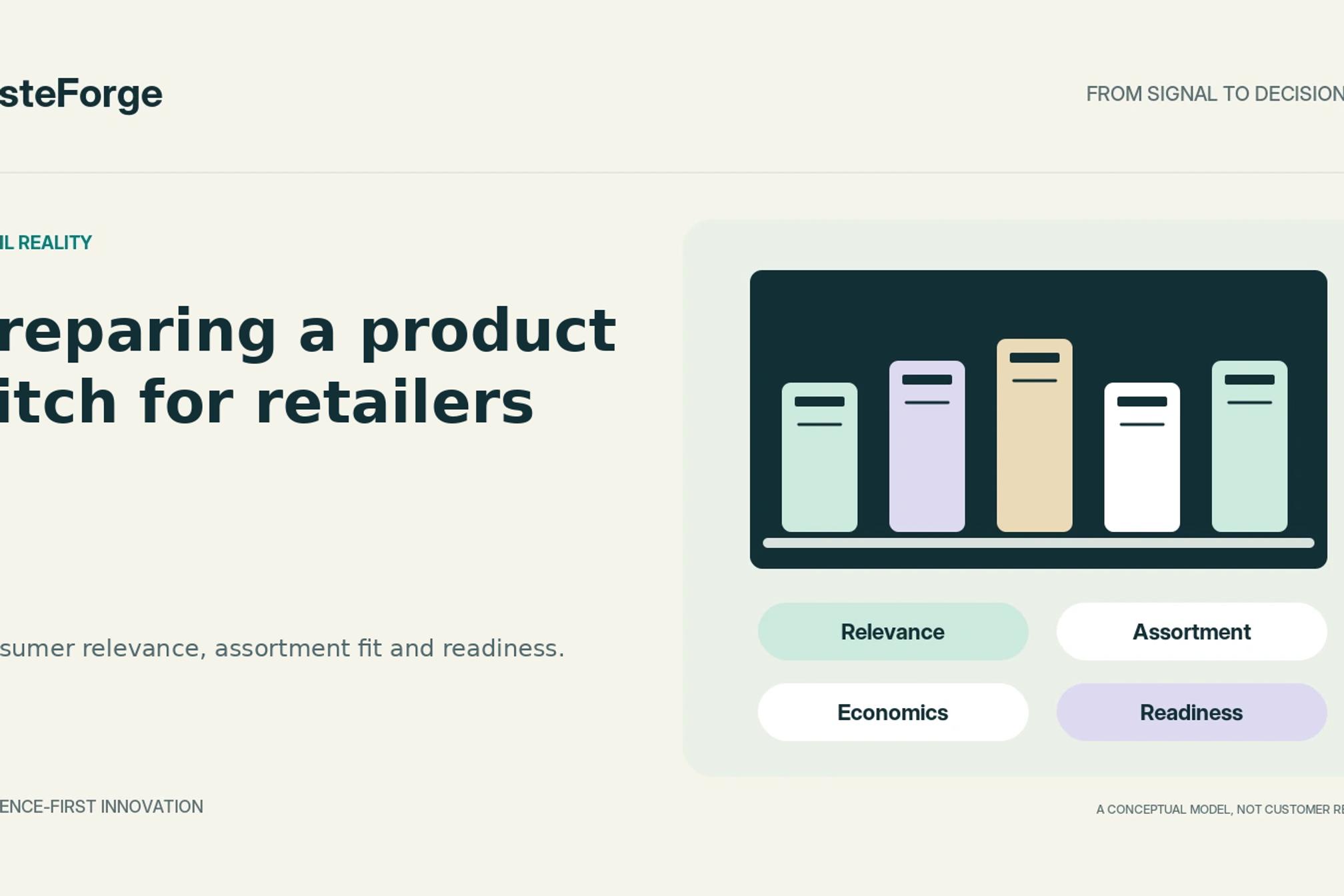
Build the case for consumer relevance, assortment fit, commercial value and delivery readiness.
Preparing a retailer pitch starts with the commercial request: which product the supplier wants listed, in which part of the assortment, under what conditions. The supporting case needs to explain who would buy it, what it adds and how the supplier will deliver.
For a new product, that work should run alongside concept development. Questions about pack size, price, expected demand and supply readiness can influence the proposition while changes are still practical.
The framework below shows how to assemble those inputs into a clear retail argument and identify the evidence still needed before the conversation.
Define the listing request and proposed launch conditions
A useful pitch starts by making the requested commitment explicit.
Is the supplier seeking a discussion of a concept, a limited test, a regional listing or a broader assortment decision? Which channel and shopper occasion are relevant? What would the next commitment require from both parties?
A general statement that the product fits a trend cannot answer those questions. Nor should exploratory evidence be presented as support for a larger commitment than it can justify.
The request determines the argument. It also determines which unresolved questions must be answered before the meeting.
Connect the consumer need to a role in the assortment
A concept can appeal to a consumer without having a clear role in a particular assortment.
Specify the occasion, the current alternative and the reason to choose the proposed product. Then explain whether the intention is to serve an unmet need, attract a different shopper, support a trade-up or improve an existing offer.
These are hypotheses until supported. State what evidence exists and what a test should examine.
NIQ's research on early launch performance distinguishes trial from repeat and uses category- and market-specific benchmarks. That is a useful reminder that initial interest and sustained purchasing should not be treated as the same outcome. [1]
In the pitch, avoid converting stated interest into expected sales without explaining the additional assumptions.
Explain the sources and assumptions behind expected demand
"A large market" is not a volume plan.
For an illustrative snack extension, potential sources of demand might include existing buyers changing flavour, new buyers entering the brand or shoppers choosing the product for a different occasion. Each has different implications for the supplier's portfolio and the retailer's assortment.
Do not present them as additive growth simply because they appear in separate slides. Some may describe the same people or substitute for existing purchases.
A responsible argument distinguishes observed behaviour, research-based expectations and scenario assumptions. It identifies what is still unknown about substitution and repeat.
That does not weaken the pitch. It gives the commercial team a clearer basis for proposing a test and agreeing how the outcome will be assessed.
Link each retailer-pitch claim to its supporting evidence
We suggest preparing an evidence map before designing the presentation.
Claim to support: The product addresses a relevant need
Evidence or check to prepare: Appropriate consumer research and a clearly described occasion
Limit to keep visible: The finding applies to the tested population and proposition.
Claim to support: It has a distinct assortment role
Evidence or check to prepare: A current review of relevant alternatives
Limit to keep visible: An apparent gap may reflect incomplete coverage.
Claim to support: The proposition works at the proposed price
Evidence or check to prepare: Research on that offer and a clear commercial model
Limit to keep visible: Appeal at one price does not establish demand at another.
Claim to support: Supply is credible
Evidence or check to prepare: Relevant feasibility checks, quotations and delivery planning
Limit to keep visible: A preliminary discussion is not a confirmed capability.
Claim to support: A test can be evaluated
Evidence or check to prepare: Measures, observation period, baseline and responsibilities
Limit to keep visible: A short test may not resolve longer-term repeat or profitability.
This is a suggested preparation framework, not a substitute for a retailer's requirements, current technical standards or commercial agreements.
Confirm product, supply and launch readiness
A pitch should distinguish the concept the team intends to deliver from the product it has already demonstrated it can deliver.
Specification, packaging, shelf life, production capacity, logistics and product information belong in the preparation where relevant. Confirm the actual requirements and deadlines with the current authoritative sources and counterparties rather than relying on a copied historical calendar.
A new format can affect more than presentation. It can change the manufacturing process, transport assumptions and the way the shopper evaluates price. Those consequences should be investigated, not hidden inside the phrase "line extension."
Make open readiness items visible internally, with owners and dates. The commercial team should not discover them through questions it cannot answer in the meeting.
Use a limited trial to resolve outstanding questions
When a material uncertainty remains, consider whether a bounded test is the appropriate request.
Define what the test should reveal and what conditions would make its results interpretable. Record availability, the actual price, promotion and execution conditions where these matter. Otherwise a disappointing result can prompt arguments over whether the product, the proposition or the execution was responsible.
The purpose is not to guarantee a favourable outcome. It is to agree what can be learned and which later decision the learning will support.
A failed assumption discovered in a small test may be more useful than an unexamined assumption carried into a larger commitment.
Apply retailer feedback to product development
The retailer conversation can reveal a missing part of the innovation case. Record it as a question to resolve rather than an objection for the presentation team to word around.
Did the discussion challenge the intended occasion, the price proposition, the assortment role or delivery readiness? What evidence would answer that challenge? Which part of the concept or plan might change?
This is one practical reason to connect innovation and commercial work. At TasteForge, it is part of the decision-support direction: retain the relationship between evidence, concept choices and the argument taken to market.
Before opening the slide deck, write the requested retail decision and the five claims that must hold for it to make sense. Then check the evidence behind each.
Source
[1] NielsenIQ, Launch Fast, Learn Faster (2026), on trial, repeat and category-specific launch assessment. Not a universal listing rule or a guarantee of retail acceptance. https://nielseniq.com/global/en/insights/report/2026/launch-fast-learn-faster/