
15 Sept 2026 · 5 min read
Identifying product opportunities from market and consumer insights

A practical approach to evaluating market signals, consumer needs and the opportunities your business can pursue.
A useful product opportunity connects a consumer need with a proposition the business can realistically develop and bring to market. Finding that connection requires evidence about the market, the intended shopper and the company's own capabilities.
Consider a hypothetical ingredient trend. Search interest, competitor launches and consumer research each offer a different view of its potential. The team needs to understand what those signals establish, whether they apply to its market and which product direction is worth investigating.
The approach below moves from checking the evidence to defining an opportunity hypothesis, with company fit and commercial feasibility included throughout.
Check the origin and independence of market signals
Three sources can look like confirmation. They may simply be repeating the same study.
A supplier presentation cites an industry article. The article summarises a research report. A social post quotes the article. Counting them as three independent pieces of evidence would overstate what the team knows.
The useful question is not how many links appear beneath a conclusion. It is what observations those links ultimately rest on.
Trace the origin. Separate measured behaviour from stated intentions, commercial promotion and editorial interpretation. Check the market, the population and the date. Ask whether apparently different sources share an underlying dataset or incentive.
Independent evidence can strengthen a hypothesis. It does not remove the need to assess quality and relevance. Nor does a fixed quota of three sources turn an uncertain proposition into a validated opportunity.
Define the consumer need, occasion and existing alternatives
An ingredient, claim or format is not the same as a consumer need.
For a hypothetical protein snack, the relevant question might be whether a particular group wants a convenient afternoon option at a particular price. The protein content is one possible part of the response, not the whole opportunity.
Another group may value portability or familiarity more. Another may not see a reason to change its existing choice at all.
A useful research brief therefore names the consumer, the occasion, the existing alternative and the proposed reason to switch. It also names what is still uncertain.
This is not an argument against trend research. It is a requirement to connect the trend to a decision that can be investigated.
Assess opportunities against company capabilities and constraints
Imagine two businesses evaluating the same ingredient. This is a hypothetical comparison.
The first already handles it, has a suitable production process and can test a line extension through an existing route to market. The second would need a new supplier, different equipment and a substantially higher price point.
Their different capabilities lead to different options for acting on the same market signal.
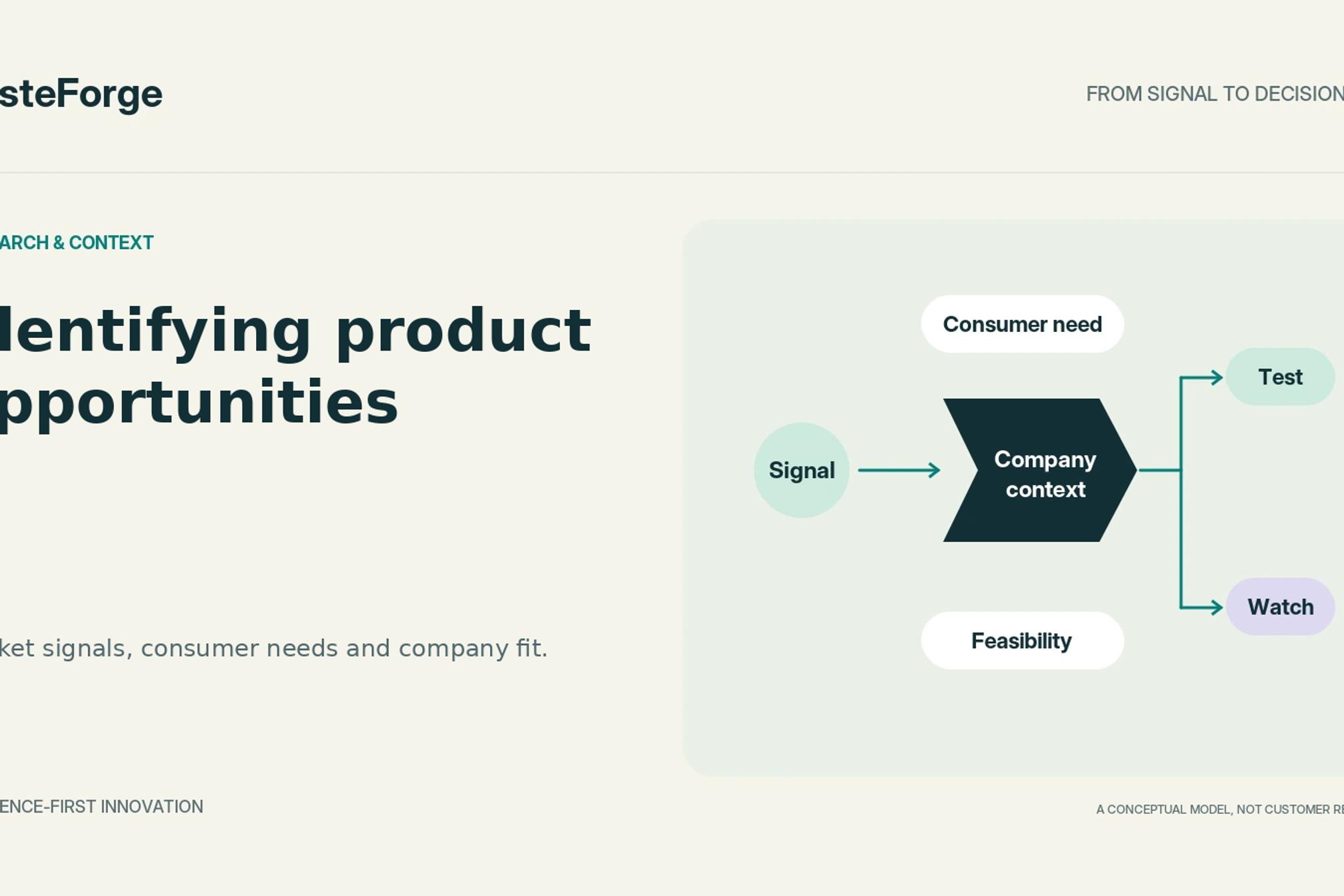
The first business may have a sensible test available. The second may be better served by watching the trend, finding another way to meet the need or choosing not to participate.
Company context helps determine which findings deserve action and which should remain under review.
That context includes the portfolio, capabilities, constraints, strategic priorities and the choices the business can realistically make. It also includes existing commitments. An attractive new option can still be the wrong use of a constrained team's attention.
Investigate demand and feasibility in apparent market gaps
An apparent gap on a category map needs further investigation.
Perhaps nobody has served the need well. Perhaps the apparent gap comes from incomplete product coverage. Perhaps the economics or shopper demand do not support the proposition.
The next step should test these competing explanations rather than celebrate the gap prematurely.
Scale also needs context. NIQ's analysis of small CPG brands describes how some targeted innovations sustain themselves through factors such as repeat purchasing and a justified premium, despite relatively slow sales velocity. That supports a more specific assessment than treating every niche as either an obvious opportunity or a failure to achieve mass scale. [1]
The task is to determine what makes an opportunity attractive for this business, not to fill every empty cell.
Write an opportunity hypothesis with supporting evidence
We suggest a simple sentence structure:
"For this consumer and occasion, there may be a useful unmet need that this business can address through this product direction, provided these assumptions hold."
Then attach the evidence for each part of the sentence.
A behavioural observation may support the occasion. A product audit may clarify the alternatives. An internal capability assessment may support feasibility. A supplier quotation may change the economics. None should be silently asked to prove more than it can.
Include the strongest reason the hypothesis might be wrong. This is not defensive writing. It directs the next research task towards information that could change the decision.
The next useful action might be a small consumer test, a product audit, a supplier conversation or a more careful look at an existing dataset. More research is not automatically better; research that resolves the material uncertainty is more useful.
Link ongoing research to active opportunities
A continuous research function should have more to do than deliver a stream of interesting links.
It should know which hypotheses are active, which assumptions are fragile, which sources need refreshing and who is waiting for an answer. When a relevant signal changes, it should help the team identify which decisions deserve another look.
This is a design direction, not a claim that every element is automated today. At TasteForge, it connects our work on research, company context and the visibility of data coverage to the practical needs of an innovation team.
The objective is to keep the evidence relevant to the choices the team is considering.
A trend can be real and still be irrelevant to your next investment. A small signal can matter greatly when it changes an important assumption. A promising opportunity can become a watch item when the conditions are not right.
Before adding a trend to your innovation pipeline, complete this sentence: it matters to our business because it changes this decision.
Source
[1] NielsenIQ, How small CPG brands can succeed with innovation (2022). Historical analysis of targeted innovations; not a forecast for a particular company or a current category-growth estimate. https://nielseniq.com/global/en/insights/analysis/2022/how-the-small-can-succeed/