
15 Sept 2026 · 5 min read
Measuring the value of an innovation intelligence pilot

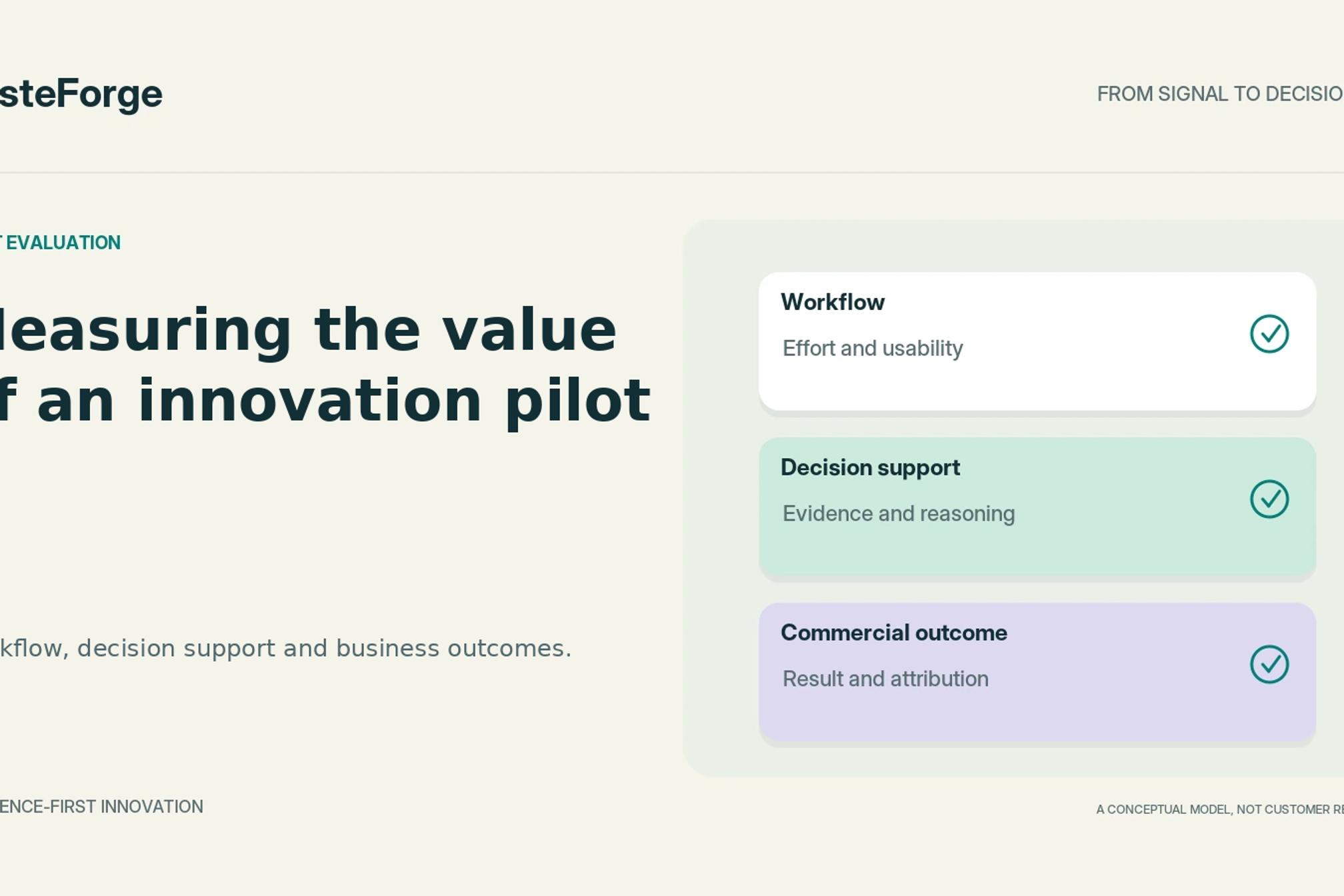
Define baselines, evaluate workflow and decision-support quality, and plan how to track business outcomes.
An innovation intelligence pilot should give the buyer a clear basis for deciding whether to continue, adapt or expand the work. That requires agreement on the workflow being tested, the expected benefit and the evidence needed to evaluate it.
Useful measures may include time spent assembling a brief, the quality of its evidence, ease of review and the completion of agreed follow-up actions. Commercial results may require a longer observation period, particularly when the pilot ends before the product reaches the market.
This article proposes a measurement structure that separates those levels of value and makes the assumptions behind the business case explicit.
Choose a representative innovation workflow
Start with one bounded workflow that matters to the sponsor. For example, a team could evaluate an existing product range, compare line-extension options or prepare an evidence-backed concept review.
State the decision the workflow supports. Identify the people who will use the output and the systems or sources involved. Define what will remain assisted by the supplier and what users are expected to do independently.
A demonstration built entirely by the vendor can be valuable, but it should not be presented as proof of autonomous use by the customer.
Make that boundary part of the evaluation rather than a surprise in the commercial discussion afterwards.
Establish a baseline and comparison method
Document how the work is currently done. Which people contribute? How much active effort does it take? What delays arise from waiting rather than working? Which output is considered acceptable?
Use a comparable task or clearly describe the differences. A new, simple brief should not be compared with a historically difficult project as though the tasks were identical.
A baseline can be imperfect and still useful when its limitations are visible. It becomes misleading when those limitations disappear from the summary.
Keep the cost of onboarding, data preparation, review and support in view. A fast generated output can still depend on substantial work elsewhere.
Measure workflow, decision-support quality and business outcomes
The first level is workflow value. Can the team assemble and revise the decision material with less avoidable effort? Can another colleague use it without reconstructing the work?
The second is decision-support quality. Are material claims traceable? Are assumptions and gaps visible? Does the process help people compare options and understand why the assessment changed?
The third is commercial outcome. What happened after the decision was executed? That may require a longer observation period and a stronger comparison than the pilot can provide.
Keeping these levels separate does not diminish early value. It prevents an operational improvement from being overstated as a proven market effect.
Build a pilot scorecard with defined evidence sources
We suggest agreeing a short scorecard before work starts. The table offers candidate measures, not universal targets or promised TasteForge results.
Question: Did the workflow become easier?
Candidate measure: Active team-hours and elapsed time to an agreed usable output
Important qualification: Include preparation, review and supplier assistance.
Question: Is the evidence inspectable?
Candidate measure: Share of material claims with a checkable source and stated scope
Important qualification: A link alone does not establish that the source supports the claim.
Question: Are uncertainty and assumptions clearer?
Candidate measure: Reviewer assessment against an agreed rubric
Important qualification: More recorded gaps can mean better visibility, not worse data.
Question: Can users work independently?
Candidate measure: Completion of the task with recorded assistance
Important qualification: Separate onboarding from recurring support needs.
Question: Can the work be reused?
Candidate measure: A second colleague or project reuses the relevant evidence and reasoning
Important qualification: Opening an old document is not the same as useful reuse.
Question: Did a commercial outcome improve?
Candidate measure: Predefined market or business measure, when observable
Important qualification: Attribution and execution conditions need separate assessment.
Choose only the measures needed for the pilot's claim. An oversized scorecard can become another administrative burden.
Check the accuracy and usability of the outputs
A faster brief that misstates the evidence is not a successful outcome.
Use a review method that checks both supported conclusions and important omissions. Include examples where the right response is uncertainty, a request for more information or a decision not to make a recommendation.
For AI-enabled systems, record what was evaluated and under which conditions. The NIST AI RMF provides a useful reference for making measurement and ongoing risk management explicit; it does not certify a product or prescribe this pilot scorecard. [1]
Where a prediction is part of the pilot, evaluate its defined target against an appropriate baseline. A convincing explanation and an attractive user interface do not substitute for predictive evaluation.
Calculating time savings and their business value
Time released from a workflow can be useful. Its business value depends on what happens to that capacity.
Record the observed difference first. Then distinguish potential capacity value from realised cost savings. Include the cost of the tool, implementation and ongoing review where an economic case is presented.
Do not add overlapping benefits together. Faster research, faster briefing and a shorter cycle may partly describe the same released hours.
Similarly, a concept stopped before launch is not automatically an avoided loss. The business does not observe what would have happened under the unchosen alternative.
These distinctions make a commercial case more credible, not less ambitious.
Agree the criteria for continuing or expanding the pilot
Define what would support continuation, expansion, redesign or stopping. Agree who owns that assessment and what evidence must be available.
The outcome might be a useful assisted service, a workflow ready for wider deployment or a clear technical or adoption gap. Each can be an honest conclusion. None should be hidden to preserve a success narrative.
At TasteForge, the standard we want a pilot to meet is straightforward: demonstrate value in a real innovation workflow, preserve the evidence of that value and make the next investment decision clearer.
Before beginning a pilot, write the sentence you would like to be able to defend at the end. Then design the measurement that would justify it.
Source
[1] NIST, AI Risk Management Framework 1.0, Core. Used as a reference for evaluation and risk-management principles, not as validation of this scorecard or TasteForge. https://airc.nist.gov/airmf-resources/airmf/5-sec-core/