
15 Sept 2026 · 5 min read
Connecting business intelligence with product innovation

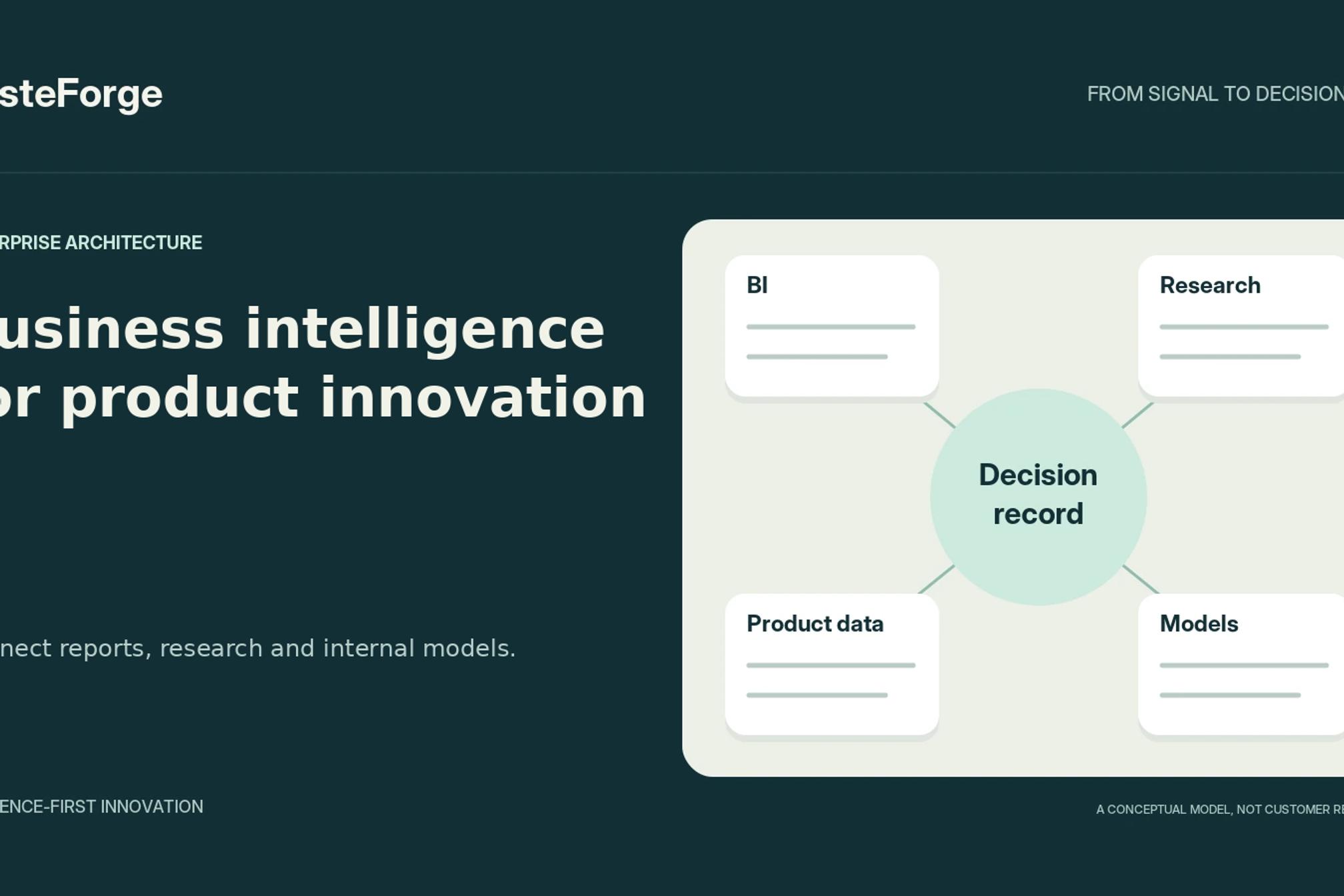
How existing reports, research and internal models can support concept evaluation and product development.
An innovation decision may draw on a sales dashboard, a consumer study, a product specification and an internal forecast. Connecting those inputs requires clarity about where each is maintained, who owns it and how it reaches the team evaluating the concept.
This article considers how business intelligence and product innovation can work together within an existing enterprise setup. The focus is on the handoffs: moving relevant evidence into a review, tracing assumptions back to their source and returning the outcome to the systems that need it.
A useful starting point is one real workflow, such as assessing a line extension, with explicit responsibilities for the data, models and decision.
The roles of BI, research and innovation decision support
It is tempting to divide the market into tools that only describe the past and tools that decide the future. That distinction is too crude to be useful.
For example, Microsoft's Power BI documentation describes parameters that let report users interact with modelled scenarios. Scenario work is not exclusive to a new class of innovation software. [1]
The meaningful question is whether the organisation has a connected process for the decision at hand. Can it link analysis to alternatives, business constraints, an accountable choice and subsequent learning? The answer may involve extending existing tools, adding a specialised layer or changing the operating process.
A credible supplier should explain its contribution without understating the capabilities already in the customer's environment.
Define responsibilities for data, models and decisions
We propose a simple responsibility map. It describes functions, not a fixed software architecture or a claim that one product must own each row.
Function: Source systems and data platform
Responsibility in an innovation decision: Preserve operational records, definitions, access controls and reliable data transformations.
Function: BI and analytical tools
Responsibility in an innovation decision: Explore performance, compare measures and expose analytical views or scenarios.
Function: Research partners and research tools
Responsibility in an innovation decision: Investigate consumer, market and technical questions with appropriate methods.
Function: Product and project systems
Responsibility in an innovation decision: Maintain specifications, versions, responsibilities and delivery work.
Function: Decision-support process
Responsibility in an innovation decision: Connect alternatives, evidence, assumptions, constraints, approvals and review triggers.
The same system may cover several functions. What matters is whether ownership and handoffs are explicit.
A decision layer should not quietly become a second authoritative product catalogue, a duplicate finance model and a separate permissions regime. That creates new reconciliation work rather than removing it.
Trace the information handoff for one product concept
Consider a hypothetical line-extension review. The category team uses existing reporting to understand the current portfolio. A research partner evaluates a concept. Operations provides a feasibility assessment. Finance supplies a cost model.
The decision team needs to compare the extension with alternatives, understand where the inputs disagree and choose the next commitment.
Start by making that one handoff work. Preserve the identifiers and versions of the products being discussed. Keep the meaning and time period of each metric. Make the relevant sources reachable by authorised users. Record which inputs are missing or not comparable.
If the concept changes from one pack size to another, the earlier research should not automatically be treated as validation of the new proposition. If a cost assumption changes, the decision brief should identify which scenario used the old value.
That continuity is the capability to evaluate. The number of connected applications is not, by itself, the outcome.
Use internal models within their validated scope
A business may already have a forecasting model, a pricing model or a set of validated decision rules. Integration should begin by understanding what each output means and where it can be used.
What is the predicted event or quantity? Which market and time horizon does it cover? What conditions must hold? How was it evaluated? How does the team know when the output is no longer appropriate?
A specialised innovation interface can potentially make that output easier to use alongside other evidence. It should not strip away its limits or relabel a prediction as a recommendation.
Nor should a new model be presumed superior because it is newer. Compare candidate approaches on the actual task, including the cost and effort of maintaining them.
Deciding what to build internally and what to buy
An internal team may reasonably keep control of its data definitions, proprietary models and strategic approval rules. It may also decide that building and maintaining a complete innovation workflow is not the best use of that team's capacity.
Evaluate the boundary explicitly. Which capability differentiates the business? Which is recurring infrastructure? Who will maintain connectors, access controls, evidence versions, evaluation and user support after the pilot ends?
Compare a realistic internal build with a realistically scoped external offer. Avoid comparing a complete vendor product with an unsupported prototype, or a small vendor pilot with an enterprise platform that does not yet exist.
The strongest argument for buying is a demonstrated capability that fits the customer's operating model. The strongest argument for building is a genuine need for control or differentiation that the available products do not satisfy.
Test the integration through one decision workflow
Before a broad integration programme, choose one workflow and its minimum useful data. Agree what remains in the existing systems, what is exposed to the decision workspace and where the approved outcome is recorded.
Run the workflow with real users. Test permissions as well as functionality. Check whether the evidence remains interpretable after it crosses the boundary. Measure manual reconciliation and handoff effort, not just the speed of generating a screen.
At TasteForge, the strategic position is complementary: make existing company knowledge, research and analytics useful in the decisions around product innovation. Specific integrations and automation levels should be evaluated against the actual implementation, not assumed from that ambition.
Do not begin with "which platform replaces our current stack?" Begin with "which decision is still poorly supported, despite the stack we already have?"
Source
[1] Microsoft Learn, Create and use parameters to visualise variables in Power BI Desktop. Used only to establish that existing BI can support interactive scenarios. https://learn.microsoft.com/en-us/power-bi/transform-model/desktop-what-if